Preamble
Lately I’ve became interested in no-BCD diving style. It is in fact the most traditional form of diving there is, since SCUBA exists since 1943 and BCD was not introduced until 1957. Along with other purist styles of diving, the no-BCD diving is technique intensive and requires certain amount of practice. I imagine that benefits offered by this style outweigh its limitations. I see a lot of articles and forum discussions about different gear configurations, breathing and weighing techniques and other topics pertaining to this style. I don’t see enough discussions of the style’s limitations and potential hazards. After reading all the material out there one could develop an impression that it’s an ideal style of diving, but it’s not. So in this article I am going to attempt to clarify boundaries, define some limits and hopefully spark a new discussion.
I assume that the potential reader is well aware of the theory of diving so I will not go into discussion of buoyancy control, or breathing, etc beyond of what’s necessary.
Theory of no-BCD Diving
The no-BCD diving differs from other styles of diving in the way the buoyancy control is carried out. Obviously, absence of BCD puts “all eggs in one basket” – your lungs. If you are unable to compensate for the buoyancy variations that occur during the dive using only your lungs, the no-BCD dive will not be possible. So before we get any further let’s first figure out how buoyancy changes (or shifts) during the dive, and to what degree it can be controlled
- Lungs buoyancy shift (LBS) which occurs when divers expand or collapses lungs when breathing. It is a voluntary shift controlled by the diver.
- Then there are buoyancy shifts that occur in your equipment as the dive progresses and ambient conditions change. The equipment buoyancy shifts (EBS) are not voluntary and cannot always be controlled by diver, but they can (and must) be predicted and taken into account.
- Maximum buoyancy shift is the absolute difference between the minimum and maximum buoyancy of the system
As long as combination maximum EBS remains well within the diver’s maximum LBS, the no-BCD dive is possible and safe. If at any point of the dive EBS shifts outside of the maximum LBS no-BCD dive is no longer possible and becomes extremely dangerous as diver looses ability to compensate for the buoyancy shifts. Therefore “plan your dive, dive your plan” mantra becomes even more important when diving no-BCD style.
Lung Buoyancy Shift
Before we begin calculating maximum LBS let’s first mention a few measurements of the lung volume:
- Vital capacity (VC) - The volume of air that can be forced out of the lungs after a maximal inspiration. Emphasis on completeness of expiration. The maximum volume of air that can be voluntarily moved in and out of the respiratory system.
- Tidal volume (Vt) - The volume of air breathed in or out during normal respiration. The volume of air an individual is normally breathing in and out.
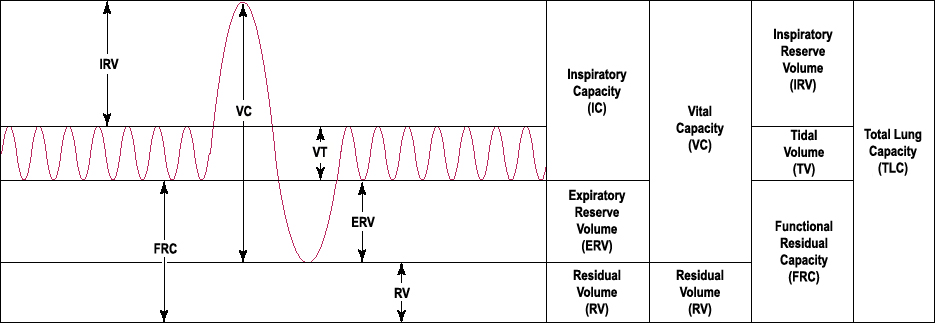
Without begin presumptuous and purely for the sake of discussion, allow me to recall the Archimedes' principle of buoyancy: any body wholly or partially immersed in a fluid experiences an upthrust equal to, but opposite in sense to, the weight of the fluid displaced (Тело впёрнутое в воду Выперает на свободу С силой выпертой воды Телом впёрнутым туды). VC and Vt equal to the volume of water displaced during breathing. The weight of the displaced water is the buoyancy.
So let’s write the formula for the maximum LBS in pounds
mLBS = VC * sF * 2.20462262
Where sF is salinity factor
The average VC is 4.6L for man and 3.6L for women. The average sF for seawater is 1.025 (although it changes from region to region as well as depth, the variations are negligible and can be ignored in our calculations). The value of sF for freshwater is 1. Now let’s plug these values in and see the results:
Maximum LBS
Man | Freshwater | 10.14 lb |
Seawater | 10.39 lb | |
Women | Freshwater | 7.94 lb |
Seawater | 8.14 lb |
The average Vt is 500ml for man and 390ml for women. Using the same formula we calculate mLBS of the normal breathing:
Normal breathing maximum LBS
Man | Freshwater | 1.1 lb |
Seawater | 1.12 lb | |
Women | Freshwater | 0.86 lb |
Seawater | 0.89 lb |
Conservatively an average man generates 10lb of positive buoyancy after maximal inhalation and 1lb of buoyancy variation while breathing normally and diving in seawater. For the ladies the values are 8lb and 0.8lb respectively.
Equipment Buoyancy Shift (EBS)
Once again our kudos to Archimedes. Thanks to him we know that buoyancy will shift if either volume or mass (or both) of a submerged object change. Therefore our usual suspects are tanks and exposure protection.
Tanks
It’s not news that different types and brands of tanks have different buoyancy characteristics (steel vs. aluminum, 80cf vs. 120cf, high vs. low pressure). Some tanks will remain negatively buoyant throughout the entire dive; others may shift from negative to positive as the amount or air drops. However, all we care about is the tank's weight shift between full and empty. The diver is responsible for finding out exact buoyancy characteristics of the given tank. This information can be obtained from a manufacturer or dive operator. However it could be beneficial to write down the average buoyancy shifts for the most common types of tanks and keep the record in the log book as a reference. Theta tank's properties that need to be recorded are: buoyancy when full, when ½ full, when 500psi, when empty. This information will become absolutely crucial when deciding on weighing options. As an example here are some values for Luxfer Aluminum 80 Tank:
Service Pressure | Capacity | Full | ½ Full | 500psi | Empty |
3000 | 80cf | -1.4lb | +1.5lb | +3.4lb | +4.4lb |
These are fairly representative numbers for the given type but could vary slightly from brand to brand
Exposure Protection
Neoprene Suits
Neoprene has microscopic air bubbles that compress under pressure reducing the volume and thus causing the buoyancy shift. The amount of shift depends on thickness of the neoprene and its type (regular, crushed or compressed). At the depth of 33 feet regular neoprene looses approximately 1/2 of its buoyancy, 2/3 at the depth of 66 feet. At about 100 feet it becomes crushed and looses almost all of its buoyancy. For example 7mm neoprene wet suit can shift as much as 20 lb during the dive. Obviously, the thinner the neoprene, the less the buoyancy shifts. The rate of compression for different neoprene suits could be obtained from the manufacturer. But keep in mind that unlike tanks where buoyancy shift depends on your air consumption and always changes towards positive, buoyancy shift of neoprene depend on the depth and can shift in either direction as you change your depths. It means under certain circumstances your combined equipment buoyancy shift (EBS) can exceed your mLBS if you didn't plan your dive correctly or failed to follow the plan.
For the sake of purity of the argument I must mention that there could be other equipment that traps air and therefore capable of shifting buoyancy; lift bags or safety sausages with some residual air, utility pockets without venting wholes, etc. Just make sure you aware of those.
Weighing Considerations
Weighing for no-BCD dive requires more attentions and precision. The weight must be set dead on. The diver cannot afford to be overweighed because there is no BCD to offset extra weight. The diver has only 8-10 pounds of mLBS to rely on and it must be enough to absorb all combined mEBS and leave enough buoyancy for comfortable maneuvering and some reserve so the diver doesn't have to breathe near the limits of the VC range. It means that you no longer can get away with ±2lb fine tuning normally available on the dive boats or at the resorts. The fine tuning should be done in ½ lb increments (8oz fishing weights could be used for that)
Before deciding on weight first you need to decide on where and when the point of neutral buoyancy (PNB) should occur and choose the weight accordingly. This is when knowledge of your equipments’ buoyancy characteristics comes to play. You will have to choose the weights in such a way that they will offset EBS of your neoprene at the predetermined depth and EBS of your tank with the predetermined amount of air left. And you need to plan your dive to be at the right depth at the right time (plan your dive, dive your plan).
Let’s dive
Let’s consider this simple scenario. Let’s say you are diving wearing skin, 2in webbing harness with to bladder, and AL80/3000psi tank with the buoyancy characteristics from the table above. Let’s say you want your PNB to occur at the safety stop (15ft / 500psi).
- Your exposure protection and harness are not compressible so it has not EBS
- Perform weight check without any equipment on (except for skin, mask, snorkel, and fins). Find weight that keeps you floating at the eye level while holding normal breath.
- Completely exhale and make sure you can sink.
- Now you know you weight. Let’s say you ended up with 6lb on your weight belt.
- Your tank is 3.4lb positively buoyant at 500psi. Add this weight to your 6lb and you end up with 9.4lb (round up to 9.5lb)
- So with 9.5lb on your weight belt you will achieve PNB at 500psi while breathing normally. In this case depth is irrelevant because you don’t have any compressible equipment that has buoyancy at different depths.
Now let’s see how your buoyancy will change as you dive progresses.
- At the beginning of your dive, while holding normal breath you weight is: -9.5lb on your weight belt, +6lb ob your own buoyancy, -1.4lb of full tank. All together -4.9lb. You should be skinning without changing your breath. At this point if you decide to come back to the surface and you take the deepest breath possible you might be able to generate at best +5lb of buoyancy to compensate for -4.9lb. You will have to swim.
- Now, in order to slow your descent you have to breathe at the top of you VC range (at the top of your lungs). You may still have to do some swimming to help your lungs to offset the negative buoyancy.
- As your dive progresses and you reach about ¾ of your air, your tank should be just about neutrally buoyant (see the table above). It reduce you negative buoyancy by about 1.4lb. It’s now -3.5lb. You can shift your breathing down the VC range, closer to the middle.
- As you reach ½ of your air, your tank is already +1.5lb buoyant. At this point your buoyancy is -2 lb. Now you can breathe at almost normal range.
- And finally when you reach your 500psi and you tank is +3.4lb buoyant, you reach your PNB at -0.1 lb.
- Now you can do you safety stop, breaching normally, easily holdings your depth.
Now let’s consider a different scenario. Let’s say you decided to have your PNB at half tank (1500psi).
- Let's reset the weight belt back to 6lb.
- Your tank will be +1.5lb buoyant at 1500psi. Add this weight and you end up with 7.5lb on your weight belt.
- So if you put 7.5lb on your weight belt you will achieve PNB at 1500psi with normal breathing.
Now let’s see how it plays out
- At the beginning of your dive, while holding normal breathe you weight is: -7.5lb on your weight belt, +6lb ob your own buoyancy, -1.4lb of full tank = -2.9lb. You should be skinning without changing your breath but this time much slower. You have plenty of lung capacity left to compensate for the downdraft. At this point if you have to come back to the surface and you take the deepest breath possible generating about +5lb of buoyancy to compensate for -2.9lb. It’s almost +2lb of lift. You will come up with plenty of comfort.
- Now that you have almost 2lb of lift in your reserve you should have no problem with slowing down your descent when reached the desired depth. No swimming will be necessary.
- As your dive progresses and you reach ¾ of your air, your tank should be just about neutrally buoyant. It will shift your negative buoyancy by about +1.4lb to comfortable -1.5lb with normal breathing. Not a problem to offset by adjusting your breath.
- At ½ of your air (the tank is now +1.5lb) you are perfectly neutral while breathing normally a the middle of your VC range.
- From this point on you will begin feeling lighter. You will have to shift your breathing further down your VC range.
- At 500psi you tank is +3.4lb, which makes your lift at normal breathing +1.9lb. It leaves you with reserve of -3lb downdraft that can be achieved if you exhale completely. That should give you enough room to offset your updraft while breathing at the bottom of you VC range. The safety stop should be manageable.
These examples demonstrate how choosing PNB can change your diving experience. Obviously such exercise could be applied to conventional diving as well. I think it’s a good idea to mentally walk through your dive plan to see how your buoyancy will change. Also these scenarios demonstrated how little room for error you will have when diving no-BCD style where 1lb buoyancy shift can be a huge deal.
Neoprene will only complicate the matter, because it would require extra weight to begin the dive. Once it looses buoyancy at the depth, you are left very little LBS left and might end up swimming a lot, which may, or may not be a problem for an individual diver.
In this particular scenario setting PNB to half tank could be a better idea, because it allowed for more comfortable dive throughout its entire duration. However if we had a different tank with even slightly different buoyancy characteristics, the decision scale could’ve tipped towards PNB at 500psi.
Conclusions
Let me just list my final thought without any particular order.
- I think that in order to make the no-BCD dive more comfortable and safe, we need to keep EBS to a minimum. It means that we need to eliminate as much equipment with buoyancy shifts as possible. I've seen arguments that it’s ok to dive no-BCD style with thicker neoprene as long as you stay shallow and keep neoprene buoyancy shifts within safe limit. While technically possible, I think it could be dangerous, especially if there is not bottom at the critical depth. If something goes wrong, and you cross the critical depth when you no longer have lung capacity to offset the loss of buoyancy, you will have to swim hard (keep in mind that neoprene stops compressing only around depth of 100 feet).
- Another thing to consider is diving with smaller tank. For example Luxfer 50cf/3000psi has 3.7lb buoyancy shift from full to empty while 80cf used in examples above shifts 5.8lb.
- The use of steel tanks could be dangerous. If you have to use steel tank (those are always negatively buoyant) you might have to match it up with neoprene to provide necessary buoyancy. But it means that when neoprene begins compressing, your downward draft will grow much faster then if it was aluminum tank.
- I think it's a good idea to avoid extreme profiles. At least at the beginning, while still searching for your groove, dive shallow, so if you you can perform emergency ascent relatively safely should you loose control.
- Be prepared that in case of emergency you or you no-BCD buddies might have problems performing rescue due to luck of extra buoyancy in reserve.
- You could have a hard time staying on the surface after the dive while waiting for the boat to pick you up. But that could be solved by inflating you safety sausage.
All things considered I believe that no-BCD diving is an excellent learning tool for peak buoyancy. Just doesn’t get any better. I think no-BCD diving is well suited for warm waters. I also think that you can dive no-BCD style while still wearing BCD. You must however make sure that there is absolutely no air in the BCD bladder. Suck it out using inflater hose and resist the urge to inflate it during dives. As the matter of fact forget about the inflater hose. Harness/wing setup could be the best configuration as you can roll up the wing and secure it with retractor bands keeping profile low. You can always inflate it in case of emergency.
I would love to get some feedback. If you find mistakes in my calculations of if you think I i'm smoking dope here, please let me know.
Thank you,
MP

do not mock me
ReplyDelete